
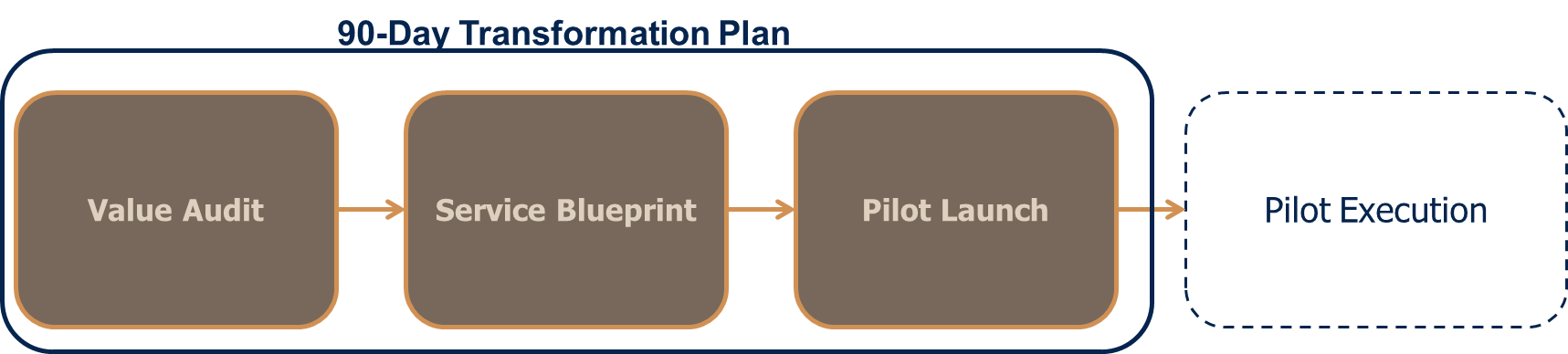
Value Audit
Identify where margin is eroding and document the Hero workflows. (Day 0-30)
Audit Revenue Leakage: Review the last 6 months of implementations to identify hidden costs (e.g., over-servicing, delayed go-lives, or unbilled out-of-scope work).
Shadow the Unicorns: Interview the top-performing CSMs/Implementation leads to document their tribal knowledge.
Gap Analysis: Compare current as-is delivery times against the target to-be profitable benchmarks.
Establish Baseline Metrics: Define current Cost to Serve (CTS) and Time to Value (TTV).
Service Blueprint
Move from “We can do anything” to “We do these specific things well.” (Day 30-60)
Define the Initial Service Product Package: Create a tiered service menu (e.g., Bronze/Silver/Gold) with fixed scopes, clear deliverables, and firm boundaries.
Standardize Onboarding Assets: Create a universal “Implementation Playbook” including:
Standard Kickoff Decks.
Project Plan Templates (WBS).
Success Criteria Checklists.
Resource Allocation Model: Define exactly when a CSM hands off to a Specialist (or vice versa) to stop the “everyone does everything” inefficiency.
Pilot Launch
Stress-test the new standards on live accounts and finalize the roadmap. (Day 60-90)
The Pilot Rollout: Apply the new standardized package to 2–3 new incoming customers.
The Services Backlog: Create a “Value Leakage Backlog” to track any deviations from the new standards for future iteration.
Feedback Loop: Conduct a 60-day review with the team to adjust templates based on real-world friction.
Final Delivery Engine Roadmap: Present the long-term plan for moving from break-even to a high-margin revenue engine.